


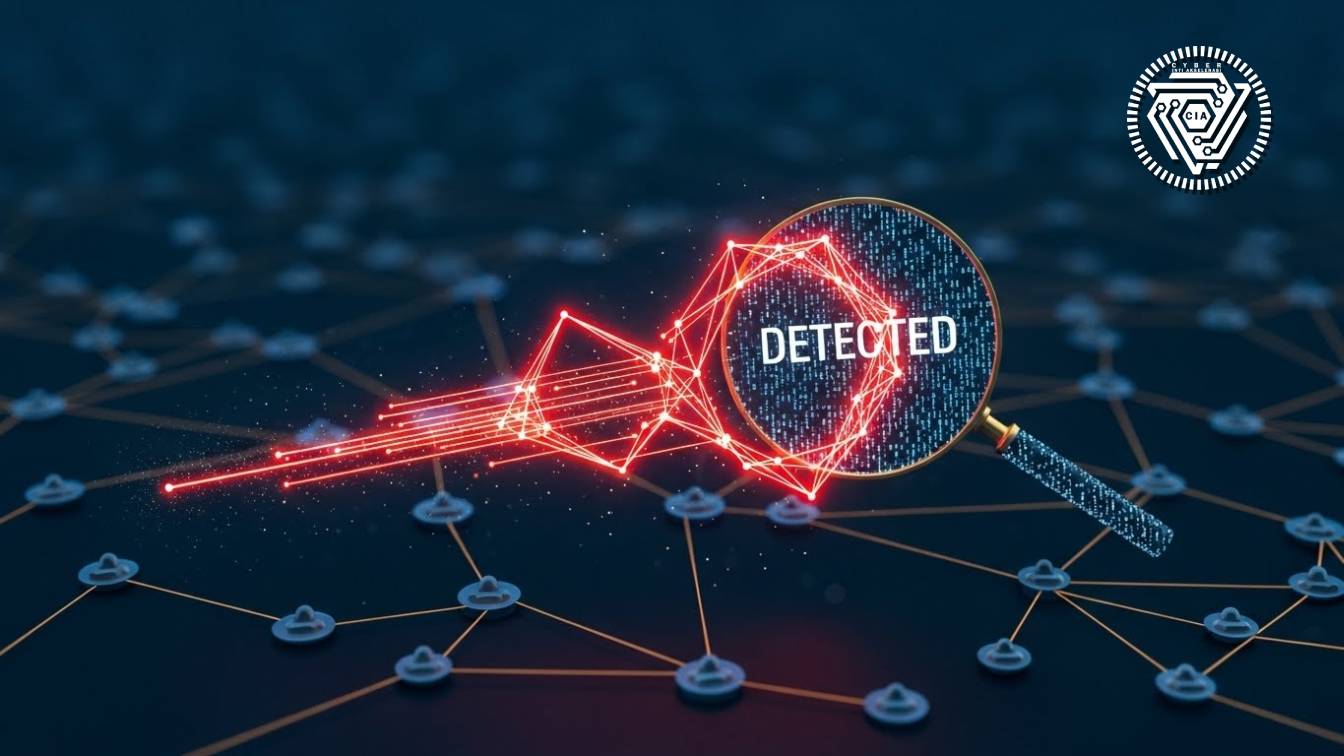
In the 2026 Fintech ecosystem, conventional fraud detection methods based on tabular data (rows and columns) like Random Forest or XGBoost are becoming obsolete. Why? Because these algorithms treat each user as an independent entity. However, modern fraud syndicates work in complex networks (ring fraud). This is where Graph Neural Networks (GNN) become crucial. GNNs do not just learn features from a single node (user), but also learn the topological structure of relationships between nodes (transactions between users).
Mathematical Study: Message Passing
The core of GNN is the Message Passing mechanism. Imagine User A is a fraudster. In a regular relational database, User B transacting with User A might look normal. However, in a graph, User A will 'send a message' in the form of suspicion weight (embedding) to their neighbors, Users B, C, and D. After several layers of propagation (multi-hop), the network can deduce that User B is part of the syndicate, even if their individual profile is clean. Research shows GNN improves collusive fraud detection by up to 45% compared to linear models.
Implementation Tutorial Using PyTorch Geometric
To start, we need to convert the transaction dataset into a Data(x, edge_index) structure. Variable x is node features (login time, device ID), and edge_index represents who transfers to whom. Use the GraphSAGE (Graph Sample and Aggregate) architecture because of its ability to perform induction on new nodes unseen during training (inductive learning), perfectly suited for dynamic banking systems.
Technical critique to note: GNNs are very GPU memory hungry. For datasets with millions of nodes (like CybermaXia client data), do not load the entire graph into VRAM. Use Neighbor Sampling or Cluster-GCN techniques to break the graph into small sub-graphs (mini-batches) without destroying structural information integrity.