


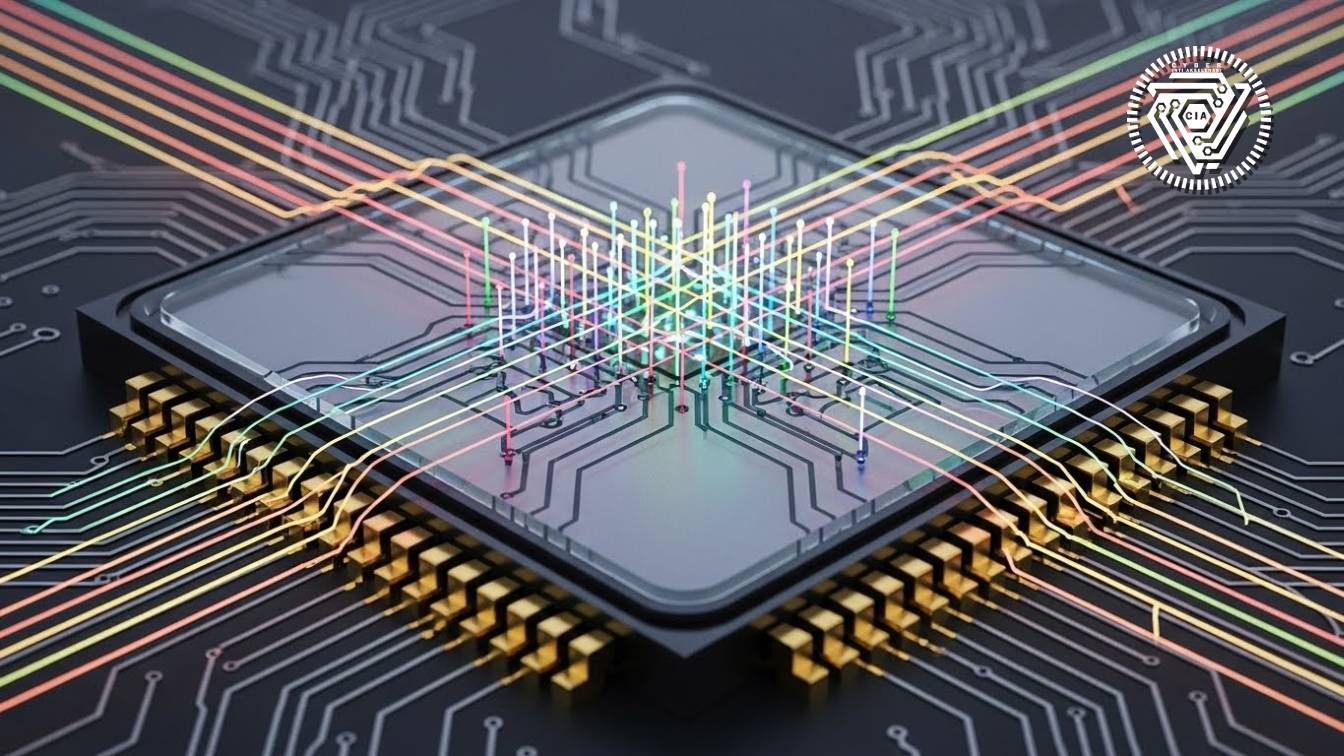
Moore's Law has officially hit a physics wall. Shrinking electron-based silicon transistors is becoming increasingly difficult without causing extreme heat. The solution for power-hungry AI computing needs in 2026 is no longer electrons, but photons (light particles). This is the realm of Photonic Computing. Companies like Lightmatter and Ayar Labs have proven we can perform mathematical operations—specifically matrix multiplication which is the foundation of Neural Networks—using light interference, not transistor switching.
Physics Analysis: Bandwidth & Latency
Why light? First, light doesn't generate resistive heat (Joule's Law) like electric current flowing in copper wires. Second, light can carry multiple different wavelengths (colors) in a single optical fiber (Wavelength Division Multiplexing), allowing strictly thousands of times greater data bandwidth per square millimeter compared to copper traces. Technical studies show photonic chips can run LLM (Large Language Model) inference with 90% lower energy consumption.
Hybrid Architecture is Key
However, we won't be discarding silicon CPUs entirely yet. The challenge with photonics is the difficulty in performing non-linear logic operations and memory storage (RAM). Therefore, the future architecture is hybrid: Photonic Chips handle massive data streams and AI matrix calculations, while Electronic Chips (Silicon) handle control logic and the OS.
For CybermaXia infrastructure, this means we must start looking at servers with optical interconnects. Our current biggest bottleneck isn't processor speed, but the speed of data moving between chips. With photonics, that 'memory wall' crumbles, allowing training of much larger AI models in record time.